Curtain semi-trailer – a type of trailer that rests with its front part on the tractor, the feature of which is sliding walls – curtains. The advantage of this type of semi-trailer is the greater strength of the awning frame compared to, for example, a flatbed semi-trailer.
Model WIELTON NS 3 K M2 curtain semi-trailer
Frame – steel construction with increased strength, the ability to move the rack boards when loading on the side end mounts, coupling plate with 2-inch pin, plywood floor. Chassis 3-axle SAF disc, air suspension, lifting axle, WABCO/HALDEX braking system, mobile racks with upper mount on rollers, 24 V electrical equipment.
Schmitz Cargobull SCS UNIVERSAL
Chassis
The MODULOS chassis has high power reserves thanks to a more evenly distributed load and optimized weight. The robust vehicle frame with one-piece profiled side members ensures high stability without thermal deformation.
Side panels
The 620 or 720 mm high side panels can be combined with a short or long sliding tarpaulin.
Inflation system
The tire inflation system monitors the tire pressure and automatically inflates the tire if necessary. This reduces tire wear and improves performance.
Load securing system
The flexible load securing system is characterized by high test loads. The system impresses with its ease of operation and can be optimally positioned in the vehicle.
KRONE Profi Liner
5630 kg – that’s how much the Profi Liner Ultra weighs. This was achieved thanks to a number of design innovations: from the chassis design and the use of light alloys (for example in the front and rear walls) to the optimization of the semi-trailer floor. The result: a significant increase in payload for everyday transport, while at the same time being suitable for forklift use with axle loads of up to 5460 kg.
Minibuses
Mercedes-Benz eSprinter
The electric model has been available since May 2020 under the name eSprinter. The van has a high roof and a permissible gross vehicle weight of 3,500 kg, as well as a maximum load volume of 11 m³. The M 780 electric motor drives the front wheels and at 116 hp can provide torque of up to 295 Nm. The 55 kWh battery provides a range of 168 kilometers (NEDC) with a maximum load of 891 kg. The second variant has 41 kWh and a range of 120 km (NEDC). This variant has only three of the four battery packs, but with a payload of 1,045 kg it is almost on par with the Sprinter with a conventional engine. In both variants, the batteries are installed under the boot floor, and as in the models with internal combustion engines, 11 m³ can be charged.
If desired, the standard AC charging option can be replaced by a DC fast charging option. This allows the battery of the larger battery variant to be charged to 80 percent in 25 minutes with a maximum charging capacity of 80 kW.
In February 2023, the eSprinter was presented with an updated engine (136 or 204 hp 400 Nm) and three battery options of 56, 81 and 113 kWh, with a range of approximately 400 km in the latter case. Fast charging (up to 115 kW) will take between 28 and 42 minutes.
Ford eTransit
In November 2020, Ford announced the 2022 E-Transit battery electric van. Production of the E-Transit began at Ford’s Kansas City Assembly Plant in November 2021. The first E-Transit vehicles were delivered to U.S. customers in February 2022. Production of the E-Transit for the European market began at Otosan in April 2022.
The liquid-cooled traction battery is taken from the Mustang Mach-E; the usable capacity is 68 kWh with a total capacity of 77 kWh. The maximum charging speed is 11.3 kW (AC) or 115 kW (DC). The vehicle’s combined charging system input is located on the front of the vehicle, below the manufacturer’s emblem. The E-Transit’s traction motor is shared with the Ford F-150 Lightning with a rated power of 266 hp. 430 N⋅m. In the UK it is offered with two traction motor outputs, 181 or 265 PS; both produce the same torque as the US model. When operating in Eco mode, power is limited to 133 PS. The claimed maximum range of 203 km (EPA) is achieved with the low-roof model. The maximum range is 317 km on the WLTP cycle. When equipped with the Pro Power Onboard option, the E-Transit can supply up to 2.4 kW of electricity for tools and accessories via conventional AC sockets.
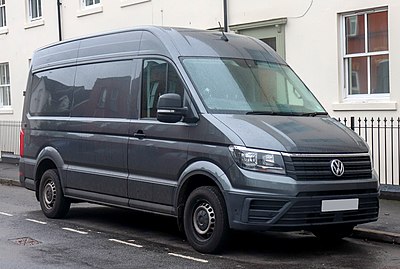
Volkswagen Crafter
In September 2016, Volkswagen presented the fully electric e-Crafter van at the IAA Commercial Vehicles show in Hanover. The e-Crafter has a 35.8 kWh battery, which provides an estimated range of 180 km. The van has a payload capacity of 1,709 kg and a cargo space of 11.3 cubic meters. The e-Crafter has an electric motor with an output of 136 hp and 290 Nm, and a top speed of 80 km/h. The electric van is ready for production, and retail deliveries began in 2017.
Trucks
Volvo FH:
The truck received a facelift in 2020, including a new headlight design, updated interior, new safety features and improved efficiency.
FH Electric
From 2022, the FH is also available with an electric drive, which was tested in the Trucker 1/22 issue in the Volvo FH Electric Globetrotter XL variant with 666 hp (490 kW) and maximum torque of 2,400 Nm and batteries with 540 kWh. Consumption per kilometer was 1.1 kWh and compared to its diesel counterpart with a consumption of 2.51 kWh (Volvo FH 500 I-Save). Range up to 300 km. Gross vehicle weight (GCW) up to 44 tons.
At the Solutrans 2023 commercial vehicle exhibition in Lyon, the Volvo FH Electric won the prestigious International Truck of the Year 2024 competition.
Scania R-Series
Scania R-Series is a series of long-distance trucks manufactured by Scania since 2004.
45R
In June 2022, electric 4×2 tractor units and 6×2/4 chassis, with R and S sleeper cabs, were introduced.
The total weight of an electric road train can reach 64 tons (for Sweden). As for the range, a 4×2 tractor unit with six 624 kW batteries has a range of 350 km at an average speed of 80 km/h. The output power of such a machine is 560 hp.
Charging from a 375 kW station allows you to provide a range of 270-300 km in an hour.
Mercedes-Benz Actros
Mercedes-Benz Actros is a truck manufactured by Mercedes-Benz since 1996. Mercedes-Benz Actros vehicles have won the title of “Truck of the Year” five times in 1997, 2004, 2009, 2012, 2019 and 2024.
In October 2023, Mercedes-Benz introduced the electric long-haul tractor eActros 600. The eActros 600 is the most advanced Mercedes-Benz truck model with modern driver assistance systems and other innovative technologies, as well as an unusual appearance. The Mercedes-Benz eActros 600 has a ProCabin cab – with a modified design and improved aerodynamics. The front optics of the tractor are installed in the bumper and are adjacent to the air intake for cooling the battery installed under the cab itself.
The manufacturer promises that after ten years of operation, the battery capacity will be at least 80 percent. The maximum range is 530 km.
Special equipment
JCB 3CX
Universal backhoe loader.
Weight: 8.58t
– Standard tires: 12.5×18-10/18.4×26-12
– Bucket width: 2.35m – Bucket capacity: 1m³
– Drive: A
– Transport length: 5.62m.
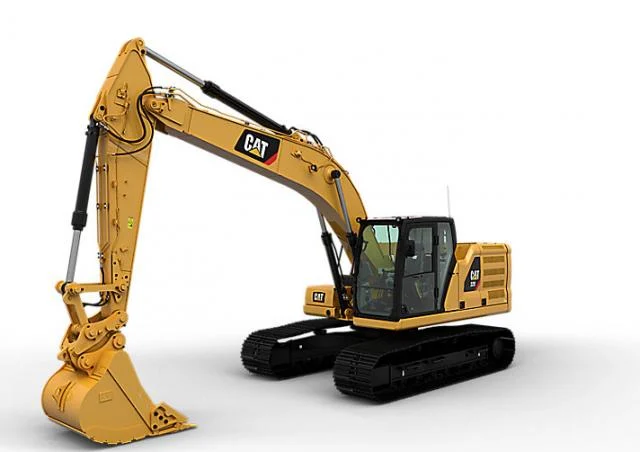
Caterpillar 320
Weight: 22.5t
– Transport length: 9.53m
– Transport width: 3.17m
– Transport height: 2.96m
– Bucket capacity: 1.19m³
– Overhead transport: LC
Check out detailed specifications, information and technical data for the Caterpillar 320 excavator manufactured between 2017 – 2025. Get a better understanding of the Caterpillar 320 excavator specification. See information such as: Weight: 22.5t – Transport length: 9.53m – Transport width: 3.17m – Transport height: 2.96m – Bucket capacity: 1.19m³ – Overhead transport: LC and more.
Komatsu WA380
High-performance front-end loader.
Weight: 17.13t
– Bucket width: 2.925m
– Bucket capacity: 3.1m³
– Control mode: KL
– Transport length: 8.295m
– Transport width: 2.925m.
Electric cars
Tesla Model 3
The Tesla Model 3 is a mid-size electric car manufactured by the American company Tesla Inc. The company has received 500,000 pre-orders for this model.
Since January 2018, the Model 3 has become the most popular hybrid and electric car in the United States, with sales reaching 114,532 cars in November 2018.
Since 2018, this model has also become the most popular hybrid and electric car in California with 12,674 cars sold, surpassing the hybrid Toyota Prius (10,043 units).
According to Bloomberg, in October 2018, the Model 3 entered the top 5 most popular sedans in the United States, surpassing the Toyota Camry.
In 2020, it became the best-selling electric car in the world with half a million cars sold.
Nissan Leaf
A single battery charge provides a maximum range of up to 160 kilometers. A full battery charge takes 8 hours with standard mains voltage. The fast charging mode allows you to recharge the batteries in about 30 minutes. The electric motor develops 107 horsepower and 280 newtons of torque per meter. The Nissan Leaf accelerates to 100 km/h in 10.8 seconds (to 60 km/h in about 5 seconds).
BMW i3
The BMW i3 (factory code I01) is a B-class electric (hybrid) car from the German company BMW, which was produced from 2013 to July 2022.
The i3 is equipped with an electric motor with a capacity of 168 hp and a torque of 250 Nm, which transmits torque through a gearbox to the rear wheels. The maximum speed of the car is limited to 150 km/h, from 0 to 100 km/h the car accelerates in 7.2 seconds (7.9 in the i3 RangeExtender version). The average energy consumption in the driving cycle is 12.9 kWh per 100 km. The average fuel consumption in the i3 RangeExtender version per 100 km of run is 0.6 liters. The car is able to travel approximately from 130 to 160 km, with the “Eco Pro+” system – more than 250 km. (In this mode, the car turns off the air conditioning system and limits the maximum speed to 90 km/h.) The i3 RangeExtender version has a 2-cylinder 650 cc gasoline engine W20K06U0 I2 with a capacity of 34 hp, which charges the batteries, thereby increasing the range to 300-340 km.
Cars
Audi A4 B9
The Audi A4 B9 is the fifth generation of the D-Class sedan and station wagon, sales of which began in Germany in the fall of 2015, immediately after the car’s premiere at the Frankfurt Motor Show in September of the same year. At the time of its launch, the model was offered with three gasoline and four diesel engines. The former are represented by a 1.4-liter turbocharged unit with a capacity of 150 hp, as well as two 2.0-liter engines with a capacity of 190 and 259 hp. The diesel engines are represented by two 2.0-liter four-cylinder engines with a capacity of 150 and 190 hp, as well as a pair of 3.0-liter 6-cylinder engines with a capacity of 218 and 272 hp. In addition, the new generation added a g-tron version running on synthetic methane. It is equipped with a 2.0-liter 170-horsepower turbo engine.
BMW 3 Series
BMW 330i Sedan: Fuel consumption in l/100 km (combined): 6.5 CO2 emissions in g/km (combined): 149
BMW 330e Sedan: Fuel consumption in l/100 km (combined): 2.5 CO2 emissions in g/km (combined): 57
The official fuel consumption, CO2 emissions, energy consumption and electric range figures were determined in accordance with the prescribed measurement procedure and comply with Regulation (EC) 715/2007 as amended.
At temperatures below 0 degrees Celsius, the purely electric driving mode of this plug-in hybrid is not available until the battery has warmed up to operating conditions after the vehicle has been driven for a few kilometres.
Mercedes-Benz C-Klasse
Mercedes-Benz C-Klasse (Comfortklasse – comfort class) is a series of mid-size Mercedes-Benz cars. The C-class designation was introduced in 1993 in connection with the division of the internal factory classification of models produced into classes by size. And although the actual ancestor of this class was the 190 model, which debuted in 1982, the first real representative of the C-Klasse was the 1993 model with the factory index Mercedes-Benz W202. On the assembly line in 2000 it was replaced by the W203, and in 2007 by the W204.
In 1996, the C-class expanded with the S202 station wagon. In 2001, it was replaced by the S203, and in 2007 by the S204. Also based on the C-class were created models of the CLK coupe, CLC liftback, and GLK SUV classes.
The C-Class rolls off the assembly lines of factories in Sindelfingen and Bremen (Germany), as well as in East London (South Africa).